Can We Talk About Property Taxes?
When someone buys a home and pays off their mortgage, the reasonable expectation is long-term housing stability. Yet every property owner quickly realizes that housing costs never truly stabilize. Instead, local governments collect an ongoing tax based on estimated land values, creating a permanent, fluctuating fee just to remain in one's home.
This constant upward pressure affects nearly everyone. Very few household incomes grow by 6% to 9% year after year, yet in many recent years property taxes have jumped by comparable mid‑single‑ to high‑single‑digit percentages in many communities. A homeowner’s tax bill can surge dramatically even if they haven't made a single upgrade to their house or received a raise at work. Because municipal tax levies increase annually and assessors re-evaluate land values based on broader regional sales, tax bills compound over time. This happens across every type of neighborhood—whether it is a modest block, a middle-class subdivision, or an established community. Even when surrounding neighbors haven't done anything out of the ordinary, regional market shifts push taxable values higher, forcing residents to absorb escalating costs for an asset they already own.
When property owners push back against local proposals—such as parks, road redesigns, or bike lanes—it is rarely because they oppose community improvements. It is a direct reaction to a funding system where every new public project threatens to push their baseline living expenses beyond what their paychecks can cover.
The Special Assessment Racket
Beyond general levy increases, local governments frequently rely on another tool that treats homeowners like piggy banks: special assessments.
When a city decides to reconstruct a neighborhood street or replace municipal utilities, it often passes thousands—or tens of thousands—of dollars directly to the adjacent property owners. City officials usually defend this practice by pointing out that the city covers a large portion of the overall project cost—such as 75%—and offers multi-year payment plans for the remainder.
To a municipal bureaucrat, a 75% discount sounds like a compromise. But to virtually any household, a surprise $6,000 assessment bill is a severe financial burden, regardless of whether a family is living on a fixed income or working full-time. And those payment plans come with a hidden catch: cities attach interest rates to them. Property owners who cannot afford to write a massive check upfront end up paying the city thousands of extra dollars in pure interest over fifteen or twenty years just to maintain the street in front of their driveway.
The legal justification for special assessments is that a newly paved street raises individual property values. But a smooth, usable road isn't a luxury upgrade—it is a baseline expectation of a functioning city.
Even if a resident rarely drives down a newly paved street on the opposite side of town, they still fundamentally benefit from it. Well-maintained streets allow emergency vehicles to navigate efficiently, keep delivery networks running, and preserve the economic health and reputation of the entire city. Infrastructure is a collective public good. Charging individual blocks for routine maintenance amounts to financial Russian roulette, dropping massive bills on whichever neighborhood happens to fall on the public works schedule that year.
The Cost of Uncertainty: A Tale of Two Systems
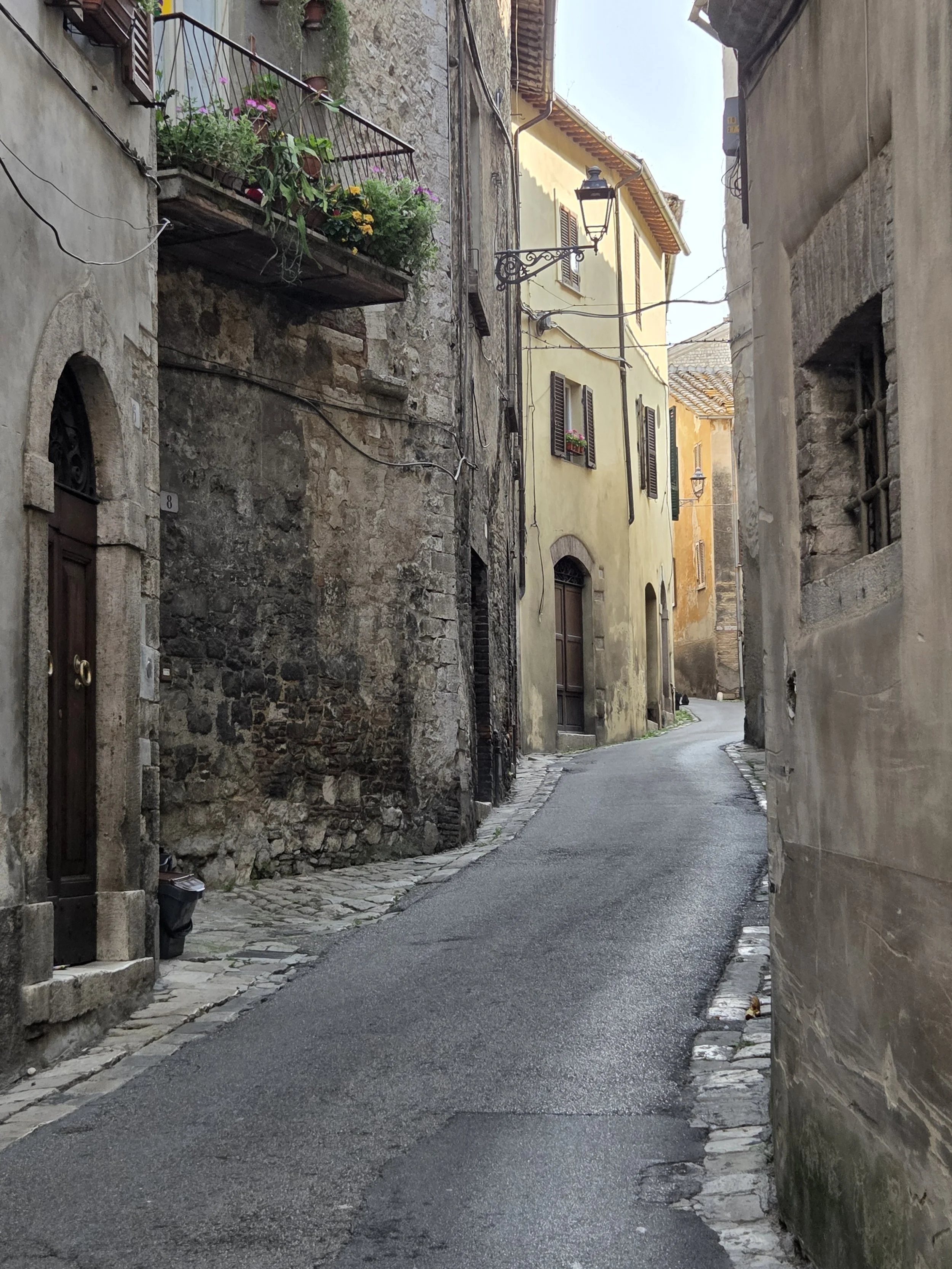
The street my apartment is on in Amelia: Via Cavour
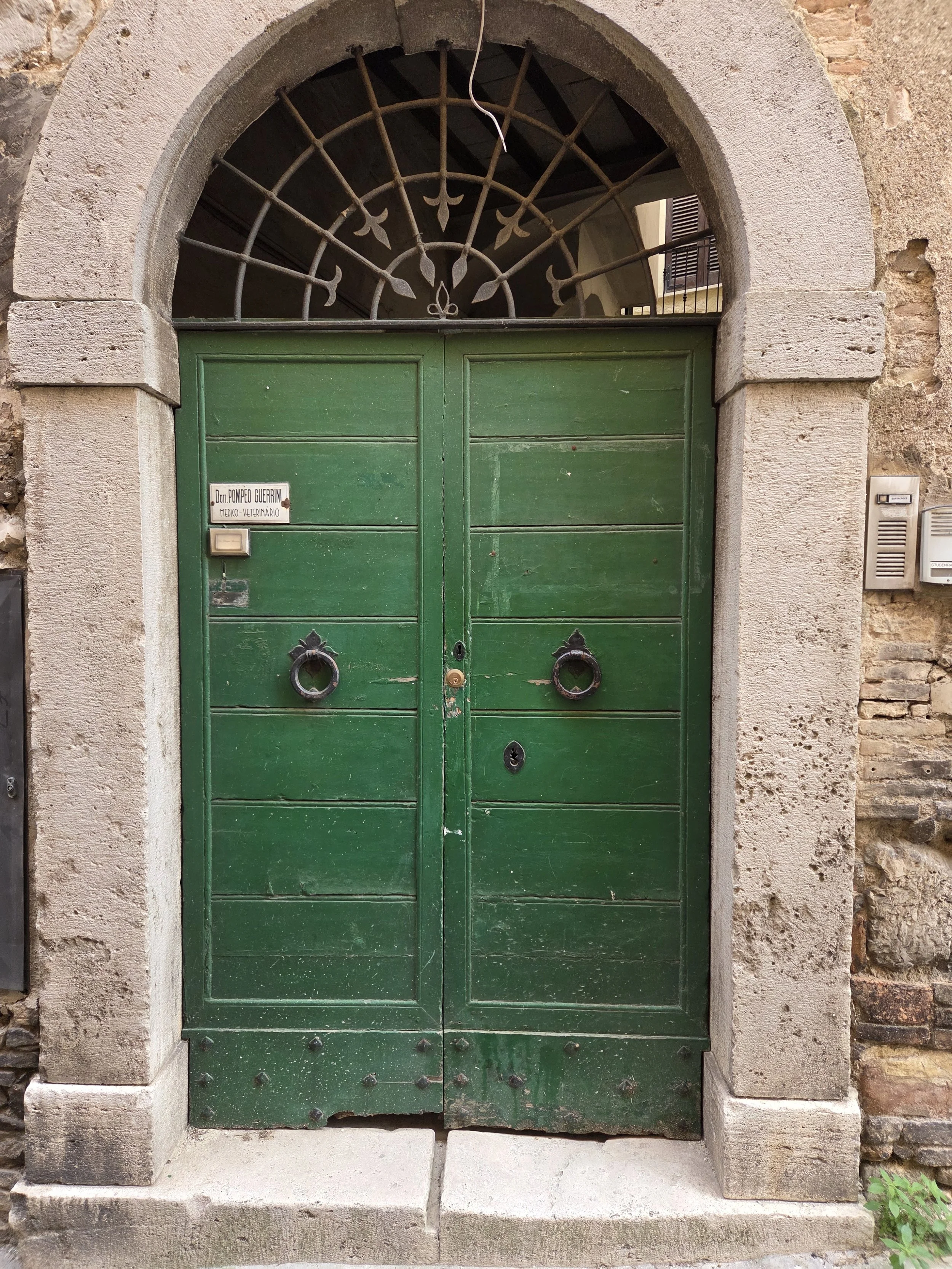
Via Cavour 54
When local leaders debate these budgets, they often try to soften the blow with micro-math. They explain that a 9.18% increase one year followed by a 6.96% hike the next year "only" equals a few extra dollars a week for the median homeowner. But that completely misses the psychological toll of a volatile system. No household can budget effectively when core living expenses are a moving target.
I happen to have a unique vantage point on this because I own property in two entirely different worlds. Aside from my home here in Minnesota, I own a small apartment in Amelia, a historic town in Umbria, Italy.
When I went to calculate my property taxes for the Italian apartment, I asked the local property management company what the bill would be. The response was a shrug and a casual: “Whatever you paid last year. I doubt it’s gone up—why would it?”
In my case, that turned out to be true: my annual IMU charge stayed at roughly €598 (~$680 USD), and it has been stable for several years running. That stability is not because Italy lacks value‑based property taxation—IMU is an annual municipal tax calculated on cadastral value, with rates set by each municipality within national bands—but because my specific town has chosen not to change its rate or assessed base.
More broadly, Italy and many other European countries use a mix of national and municipal taxes to fund local services, and recurrent property taxes are typically based on value or area and payable annually. What differs from the U.S. is less the existence of property tax itself than the degree to which core services—especially K–12 education and key social programs—are directly tied to local property values, frequent levy decisions, and voter referendums, rather than being financed primarily through more centralized national or regional revenue streams.
In the U.S., local governments treat property taxes like an adjustable-rate mortgage where the city holds the dials, and the homeowner just has to pray they don't get squeezed out of the neighborhood. Furthermore, while foundational pillars of society—like public education and parts of the social safety net—are often more centrally financed at the national level in many European countries, the U.S. relies heavily on a patchwork of state and local funding—much of it tied to property taxes—for these same services.
The Zip-Code Lottery: How Education Actually Gets Funded
Across the United States, public K–12 education relies heavily on a hybrid model. Recent national data show that, on average, about 47–49% of funding comes from state sources, about 42–45% from local sources (primarily property taxes), and around 8–10% from federal sources.
A small handful of states break the mold:
Hawaii operates a single, centralized state school district that is primarily funded through the state’s general fund—about 80–82% of operating funds in recent years—without relying on a separate local property‑tax‑based school funding system.
Vermont relies on a centralized statewide education property tax that pools revenue in the state Education Fund and then allocates it to districts based on spending per weighted pupil and statewide yield formulas, rather than simply on local property wealth.
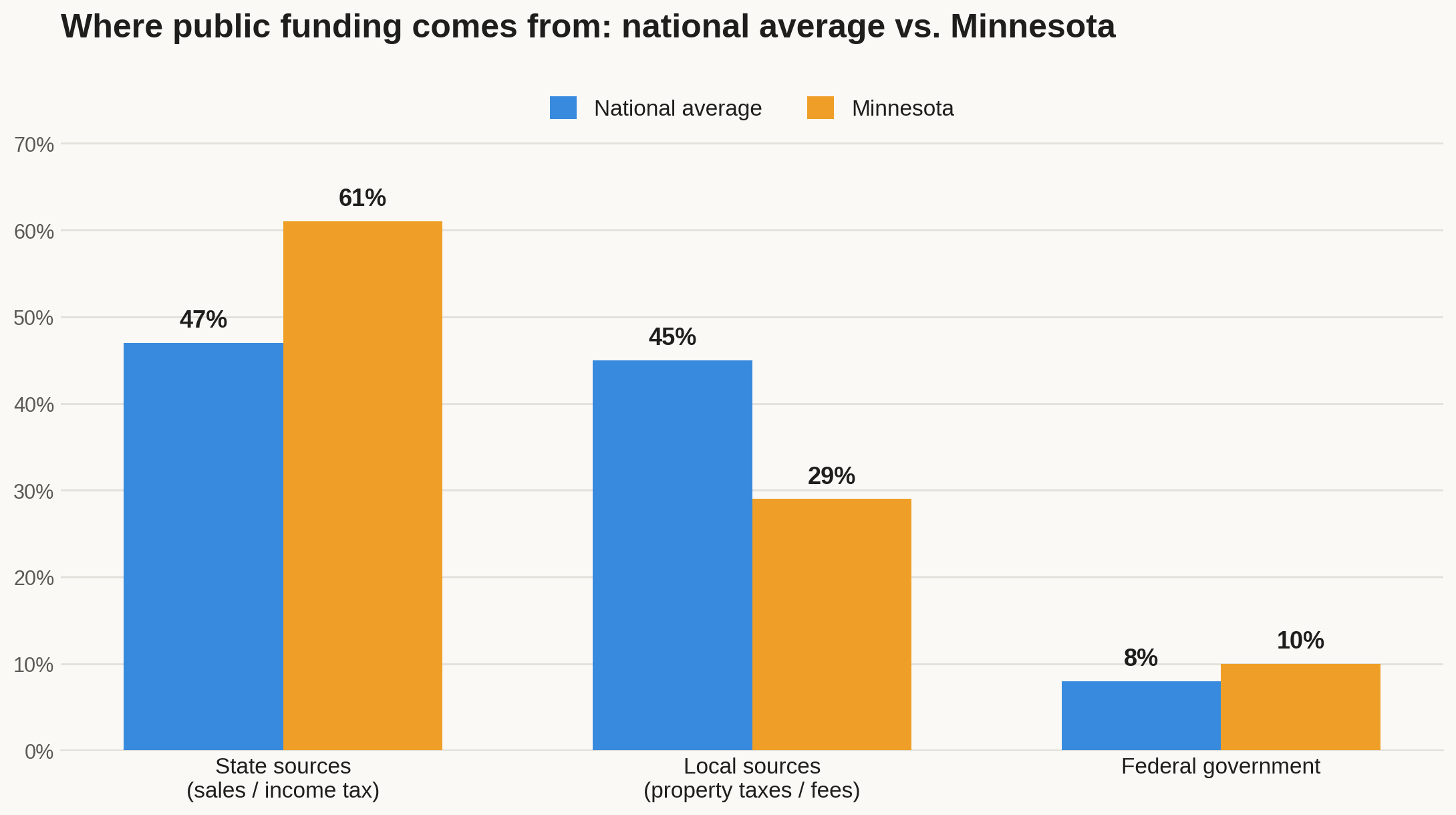
Minnesota’s public funding percentages compared to the national average
In Minnesota, state funding carries a larger portion of the baseline K–12 budget than the national average: in the 2022–2023 school year, about 60.7% of public-school funding came from state sources, 29.1% from local sources (mostly property taxes), and 10.1% from the federal government.
While Minnesota's state funding covers basic operational needs, the remaining local share introduces deep inequities. School districts are forced to rely heavily on voter-approved property tax referendums to fund capital improvements, specialized programming, and operating buffers.
This creates a zip-code lottery. Wealthy communities with expansive, high-value commercial and residential tax bases can easily pass multi-million-dollar referendums to build state-of-the-art facilities, specialized arts programs, and top-tier athletic fields. Meanwhile, lower-income districts struggle to pass basic operating levies, leaving students stranded simply because of where they live.
Beyond Schools: What Else Are We Pinning to Property Values?
It isn't just education that suffers from hyper-local property reliance. A quick look at a county or city property tax bill reveals a kitchen-sink list of broad societal burdens dumped onto local real estate:
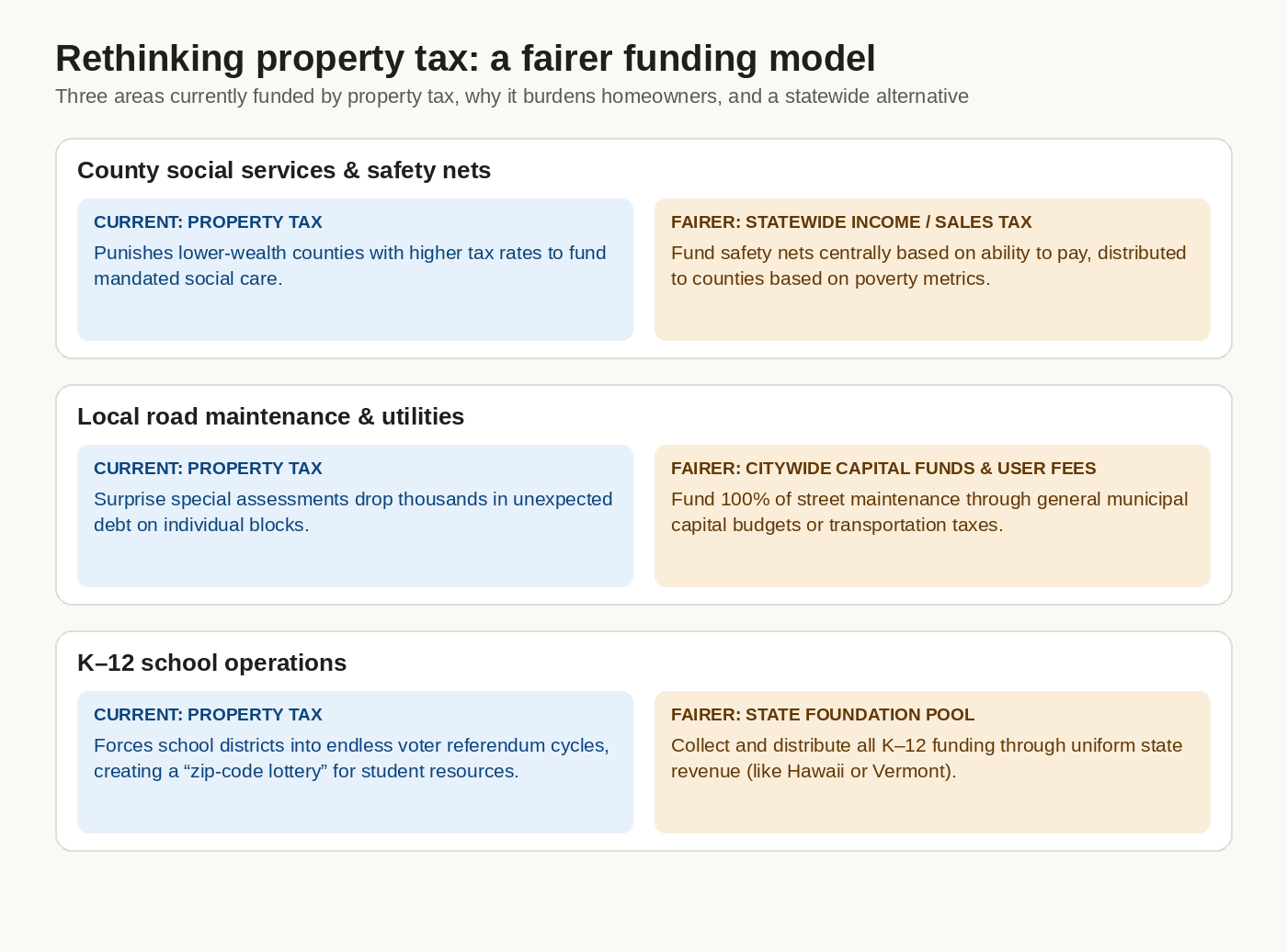
County Social & Health Safety Nets: In states like Minnesota, county property taxes help fund public health programs, child protection services, mental health services, and emergency housing, alongside state and federal funding streams.
Public Safety, Prosecution & Corrections: While Minnesota shifted district court judge salaries to the state general fund in the 2000s, local governments still finance much of the justice system—such as county attorneys, jails, probation services, and courthouse operations—through local property taxes supplemented by state and federal funds.
Regional Infrastructure & Transit: Paving arterial roads, maintaining regional transit networks, and managing environmental projects regularly trigger local property tax levy increases.
Make it stand out
Whatever it is, the way you tell your story online can make all the difference.
Using property values to finance broad human services like mental health care or county corrections creates two glaring, systemic injustices:
The "Poverty Penalty" for Homeowners: Right now, counties with the highest concentration of residents needing social support often have the weakest property tax bases. To fund mandated safety-net programs, county boards are forced to raise local property tax rates—penalizing the very working-class homeowners who are already struggling.
Decoupling Compassion from Real Estate: Property taxes are an asset tax, completely disconnected from a homeowner's actual liquid cash flow. Financing broad human needs—like foster care, addiction treatment, or mental health crisis care—through state income tax ensures the bill is paid by people with the income to support it, rather than a retiree whose only asset is a home they bought 40 years ago.
The Hidden Cost of "Saving" Money
When we fail to fund public goods fairly at the state level, we don't actually save money—we just transfer the debt to a much darker ledger.
There is an inescapable, collective price tag for an under-resourced community. When kids are denied equal educational opportunities, the fallout extends far beyond those who drop out—it includes the many who manage to graduate but walk away without the practical skills, critical thinking, or knowledge that employers and society urgently need. The broader economy suffers when businesses lose out on a well-prepared workforce, stalling growth and innovation.
And in the worst cases, individuals left behind without real paths forward turn to social safety nets or crime, leading to law enforcement, court, and intervention costs that vastly outstrip what it would have cost to fund a high-quality education and supportive community in the first place.
Moving Forward
We pay for our community one way or another. We can pay upfront through stable, predictable, and fair public funding systems that protect homeowners and invest in every neighborhood—or we can pay far more later to fix the fallout of a fractured society.
Shifted models already exist. A growing number of forward-thinking cities are eliminating special assessments entirely, choosing instead to fund 100% of street maintenance through predictable, city-wide capital funds. Statewide school funding reforms and centralized funding for county social services remain vital steps toward closing the opportunity gap and removing the burden from local property owners.
If local governments want residents to stop instinctively opposing every new project, referendum, or improvement, they must first fix the underlying engine. It is time to stop treating homeowners like endless piggy banks and rebuild a local funding system rooted in fairness, predictability, and shared responsibility.